Tax & YMYL educational disclosure: This guide explains US federal tax rules (IRS Schedule C, Schedule SE, Form 1040-ES, and Section 199A) for independent contractors earning 1099 income on remote AI training platforms. State and local tax rules vary by jurisdiction. This article is for educational purposes only and does not constitute individualized CPA or legal tax advice; consult a licensed CPA or tax attorney for your specific situation. Read our editorial policy.
Landing your first remote AI training contract on micro1.ai, Outlier AI, or DataAnnotation.tech feels incredible. You log 15 hours from your home office at $45/hour, and two weeks later, $1,350 hits your Deel or PayPal account with zero deductions taken out.
Then April arrives — and first-time contractors get hit with a painful surprise. Because remote AI platforms classify you as an independent contractor (1099-NEC) rather than a W-2 employee, the IRS considers you a sole proprietor. That means you owe both regular federal/state income tax and the 15.3% Self-Employment (SE) tax.
The good news? Being a 1099 contractor also unlocks some of the most powerful tax deductions and retirement wealth-building accounts in the US tax code. Here is the exact playbook to protect your AI side-hustle income and turn it into tax-advantaged index wealth.
File Schedule C, write off home office & calculate Form 1040-ES vouchers★★★★★Try free →
Calculate your exact quarterly IRS reserve & 20-year ETF growth★★★★★Try free →
Earn $20–$100+/hr training frontier AI models remotely★★★★★Try free →
(FTC Disclosure: The TaxAct, micro1.ai, and Monarch links above are partner/affiliate links. If you sign up, file your taxes, or get hired through them, we may earn a commission at zero extra cost to you.)
1. Why your AI training payouts have zero taxes withheld (1099-NEC vs. W-2)
When you work a traditional W-2 job, your employer automatically withholds federal income tax, state income tax, and pays half of your FICA payroll taxes (6.2% Social Security + 1.45% Medicare = 7.65%), while you pay the other 7.65%.
When you work on micro1.ai, Outlier, or DataAnnotation, you are both the “employer” and the “employee.” If you earn $400 or more in net self-employment profit during the calendar year, you must file Schedule C (Profit or Loss from Business) and Schedule SE (Self-Employment Tax) with your Form 1040.
2. How the 15.3% Self-Employment Tax is actually calculated (it’s really ~14.13%)
Many blogs claim you pay a flat 15.3% self-employment tax on every dollar you earn. In reality, the IRS gives you two important mathematical breaks on Schedule SE:
- Break #1 — Tax applies to 92.35% of net profit: You only pay the 15.3% SE tax (12.4% Social Security up to the annual Social Security wage base limit + 2.9% Medicare) on 92.35% of your net Schedule C profit (after subtracting business expenses). That makes the effective SE tax rate roughly 14.13% of net profit.
- Break #2 — The 50% “above-the-line” SE tax deduction: You get to deduct half (50%) of your Self-Employment tax directly from your Adjusted Gross Income (AGI) on Schedule 1 — even if you take the standard deduction!
- Break #3 — The 20% Section 199A QBI Deduction: Most US sole proprietors and 1099 contractors below the statutory income phase-out thresholds qualify for the Qualified Business Income (QBI) deduction, which shields up to 20% of your net qualified business profit from federal income tax (note: QBI reduces federal income tax, not the 15.3% SE tax).
3. The 4 quarterly IRS estimated tax deadlines (Form 1040-ES)
The US tax system is “pay-as-you-go.” If you expect to owe $1,000 or more in federal tax from your 1099 AI income after subtracting your W-2 withholding and credits, the IRS requires you to make four quarterly estimated payments (using IRS Direct Pay or EFTPS):
| Quarter / Income Period | IRS Form 1040-ES Due Date | Recommended Action |
|---|---|---|
| Q1 (Jan 1 – Mar 31) | April 15 | Transfer 25%–30% of net Deel/PayPal payouts into a High-Yield Savings Account (HYSA) |
| Q2 (Apr 1 – May 31) | June 15 (next business day if weekend) | Pay Q2 federal + state estimate via IRS Direct Pay |
| Q3 (Jun 1 – Aug 31) | September 15 | Pay Q3 federal + state estimate |
| Q4 (Sep 1 – Dec 31) | January 15 (of following year) | Final quarterly payment before April 15 tax filing |
💡 Pro Tip (The W-2 “Safe Harbor” Trick): If you have a full-time W-2 day job and do AI training on the side, you can avoid quarterly Form 1040-ES payments entirely by submitting a new Form W-4 to your day-job HR department asking them to withhold an extra $150–$300 per paycheck (Line 4c). As long as your total W-2 withholding covers 100% of last year’s total tax liability (or 110% if your prior-year AGI exceeded $150,000), you are 100% protected from IRS underpayment penalties!
4. Legitimate Schedule C tax deductions for remote AI trainers
You are only taxed on your net profit (Gross 1099 Income minus Ordinary & Necessary Business Expenses). Common deductions for remote AI contractors include:
- Business portion of high-speed internet & phone: If you use your home fiber internet 30% of the time for micro1/Outlier work, 30% of that bill is deductible on Schedule C.
- Dedicated hardware & accessories: A directional microphone, webcam, ergonomic chair, or laptop purchased for your contract work (pro-rated by business-use percentage).
- Simplified Home Office Deduction ($5/sq ft up to 300 sq ft): If you have a dedicated desk or room used exclusively and regularly for your 1099 business, you can deduct up to $1,500/year using the IRS simplified method.
5. How to shelter your 1099 AI income in a Roth IRA or Solo 401(k)
Don’t let your AI side-hustle money evaporate into lifestyle creep. Once you transfer 25% of each Deel or PayPal payout into your tax-reserve savings account, route a fixed percentage of your net profit straight into:
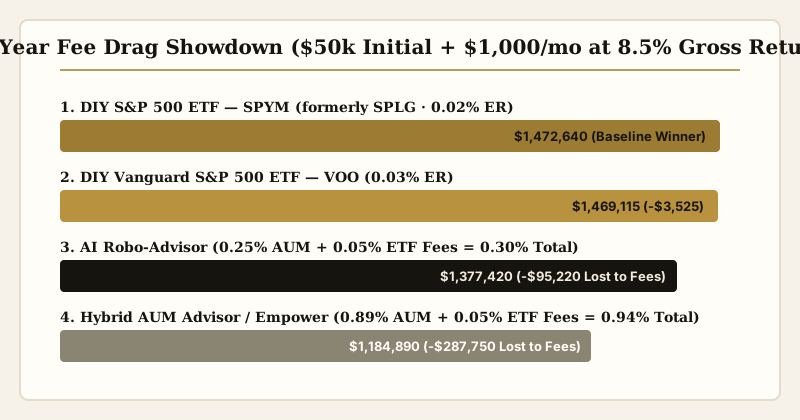
- A Roth IRA: Contribute post-tax dollars and let them compound 100% tax-free for life inside a 0.02% S&P 500 ETF like
SPYM(formerlySPLG) orVOO(0.03% ER). - A Solo 401(k) (Individual 401k): Because you are a self-employed 1099 contractor with no full-time employees, you can open a free Solo 401(k) at Fidelity or Charles Schwab. This allows you to contribute both as the “employee” and as the “employer” (up to 20% of your net adjusted self-employment income), directly lowering your taxable income!
👉 Run Your Exact Numbers Now: Use our interactive Remote AI Trainer 1099 Tax & Roth IRA Compounding Calculator to see your monthly net pay and 20-year S&P 500 trajectory.
Frequently asked questions
Will Deel or PayPal send me a 1099-NEC or 1099-K for my AI training income?
If you are a US resident paid $600 or more directly via Deel or ACH by a US entity, you will typically receive Form 1099-NEC by January 31. If you are paid via PayPal, you may receive Form 1099-K depending on current federal and state reporting thresholds. However, under IRS rules, you are legally required to report all self-employment income on Schedule C even if you do not receive a paper 1099 form.
How much should I set aside from every micro1.ai or Outlier payout for taxes?
A safe rule of thumb for most US side-hustlers is 25% to 30% of net profit. That covers the ~14.13% effective Self-Employment tax plus your marginal federal and state income tax after accounting for the 50% SE tax deduction and 20% QBI deduction.
Can I deduct the cost of ChatGPT Plus or Claude Pro on my Schedule C?
If you use paid AI subscriptions strictly for legitimate independent business research, coding projects, or productivity outside of proctored assessments (remember: never use external LLMs where prohibited by client rubrics), software subscriptions used for business are deductible under Schedule C Office/Software Expenses.
Disclaimer: MoneyPilotAI is not a CPA firm. Tax laws and IRS thresholds change annually; consult a qualified tax professional regarding your specific situation.
Put this advice to work — tonight
Our budget templates do the math for you: type your income in one green cell and see exactly where every dollar goes. Spreadsheets for Excel & Google Sheets, plus a printable planner pack.
Browse the templates → $7–$15 one-time · Instant download · Excel, Google Sheets & printable