Editorial & YMYL disclosure: At MoneyPilotAI, we personally test every AI budgeting app, portfolio scanner, and prompt workflow using real test accounts and deterministic financial models before recommending them. This guide is for educational purposes only and does not constitute personalized financial or tax advice. Read our affiliate & editorial disclosure.
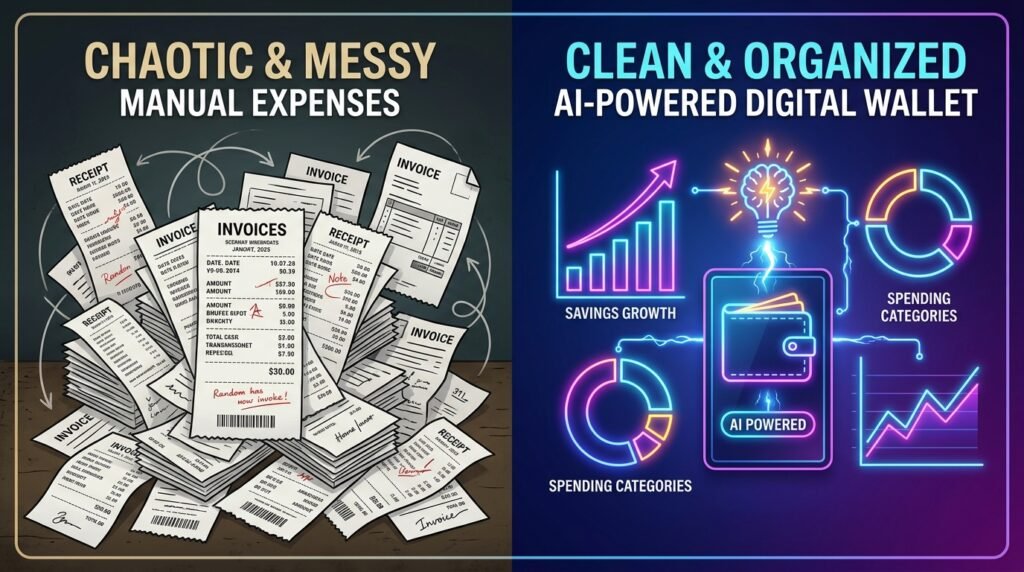
Most people don’t fail at building wealth because they don’t know the math. They fail because manual money management is exhausting.
Consumer finance studies consistently show that over 78% of people abandon manual Excel or Google Sheets budgets within 21 days. Between categorizing credit card charges, canceling forgotten subscriptions, rebalancing your Roth IRA, and checking whether your ETFs overlap, managing money feels like an unpaid part-time job.
Artificial Intelligence changes the game by shifting your finances from reactive (wondering where your paycheck went on the 28th of the month) to predictive (automatically routing cash, flagging fee leaks, and stress-testing your portfolio in seconds). Here is the definitive 2026 blueprint for using AI to manage your money safely and profitably.
Why traditional money management is broken (reactive vs. predictive finance)
For the last decade, personal finance apps were glorified digital filing cabinets. They showed you pie charts of how much you spent on restaurants last month — when it was already too late to change it.
Modern AI finance tools rely on three breakthroughs:
- Natural language categorization: Instead of lumping a $142 Amazon charge or a Venmo transfer into a generic “Shopping” bucket, machine learning models recognize recurring merchant patterns and split transactions accurately.
- Predictive cash-flow forecasting: AI analyzes your paycheck cycle, utility fluctuations, and credit card statement closing dates to predict your exact checking account balance 30 days from now.
- Instant fundamental synthesis: Large Language Models (LLMs) and AI-assisted trackers can digest a 150-page SEC 10-K filing or calculate sector overexposure across your ETFs in seconds.

Pillar 1: Automating your budget and cash flow with AI
If you hate restrictive budgets that make you feel guilty for buying a $6 coffee, AI budgeting apps are built for you. Instead of forcing you into rigid envelopes, they focus on optimizing your free cash flow.
1. Killing “subscription creep” and silent price hikes
AI budgeting engines scan your transaction history to spot recurring charges — and more importantly, they trigger an alert the moment a streaming service, gym, or SaaS tool quietly raises your monthly bill by $3.
2. Algorithmic “safe-to-spend” numbers
Rather than tracking 40 micro-categories, apps like Copilot Money ($13/mo or $95/yr — Apple ecosystem only) and Monarch Money ($14.99/mo or $99.99/yr Core; $199.99/yr Plus) calculate a single dynamic number: what you can safely spend today after accounting for upcoming rent, credit card autopays, and automated investments.
👉 Deep Dive Comparison: Read our hands-on 90-day benchmark: The 7 Best AI Budgeting & Net Worth Apps of 2026 (Tested & Ranked).
Pillar 2: Using AI to audit your stock & ETF portfolio
Can AI pick the next stock that goes up 500% next week? No — and anyone selling you an AI tool that promises guaranteed stock market predictions is running a scam.
What AI does exceptionally well is risk management, portfolio X-raying, and fundamental research.
1. Portfolio risk scanners (finding hidden concentration)
Many DIY investors hold a “diversified” mix of an S&P 500 ETF (SPYM — formerly SPLG — or VOO), a Nasdaq-100 ETF (QQQM), and individual shares of Nvidia, Apple, and Microsoft. In reality, over half of their life savings is tied to just a handful of mega-cap tech companies. Free AI-assisted trackers expose this concentration in seconds.
👉 Read Our Full Test: Google Finance AI Portfolio Scanner Tested: Our $25,000 Model Portfolio Review.
2. LLM prompt engineering for DIY investors (ChatGPT, Claude & Perplexity)
When paired with deterministic Python execution (Code Interpreter) and official fund fact sheets, general-purpose AI models like Claude and ChatGPT act like a tireless Wall Street junior analyst. You can use them to compare expense ratios (SPYM at 0.02% vs. VOO at 0.03%, or QQQM at 0.15% vs. QQQ at 0.20%), spot ETF overlap across your 401(k) and Roth IRA, and summarize bear cases from quarterly SEC filings.
👉 Copy-Paste Our Workflows: 10 ChatGPT & Claude Prompts to Audit Your Stock and ETF Portfolio.
Pillar 3: AI robo-advisors vs. passive index funds
Should you manage your own ETFs using AI research tools, or hand your money over to an automated AI Robo-Advisor like Wealthfront or Betterment (0.25% annual AUM fee)?
While automated Tax-Loss Harvesting (TLH) can generate tax alpha in large taxable accounts during volatile years, investors must watch out for three critical IRS and fee rules:
- IRC § 1211(b) Netting Order: Harvested capital losses must first offset realized capital gains dollar-for-dollar before up to $3,000/year ($1,500 if married filing separately) can offset ordinary income.
- IRS Revenue Ruling 2008-5 (IRA Cross-Account Wash Sale Trap): If your robo harvests a loss in a taxable account while your external Roth IRA, Traditional IRA, or spouse’s account auto-buys a substantially identical fund within 30 days before or after, the tax deduction is permanently destroyed.
- The Mature Portfolio “Tax-Lock Trap”: After 7–10 years of compounding, your cost basis is too low to harvest new losses, yet you keep paying the 0.25% AUM fee every year — or face a huge capital gains bill to exit.
👉 See the 25-Year Math: AI Robo-Advisors vs. S&P 500 Index Funds: Which Actually Wins After Fees & Taxes? and test your own numbers with our free Fee Impact Calculator.
Pillar 4: Bank security, Plaid OAuth 2.0 & AI scams to avoid
Connecting your checking account and brokerage portfolio to an AI app naturally raises a critical question: Is my money safe?
- Tier-1 Banks Use Tokenized OAuth 2.0: Major US institutions (Chase, Bank of America, Wells Fargo, Capital One, Fidelity) use bank-approved OAuth 2.0 APIs where Plaid receives a read-only cryptographic token and never sees or stores your password.
- Legacy Credit Unions & CFPB Rule 1033: Smaller banks without open APIs still rely on encrypted credential fallback (screen-scraping), a practice that triggered Plaid’s $58M consent/transparency settlement in 2022 and is now being phased out under the CFPB Section 1033 Open Banking mandate.
👉 Full Security Checklist: Are AI Budgeting & Finance Apps Safe? Plaid, OAuth 2.0 & Bank Security Explained.
Bonus Pillar: Increasing your investable income with AI training jobs
Cutting expenses has a floor, but increasing your income has no ceiling. Thousands of domain specialists, coders, financial analysts, and writers are earning $20 to $100+ per hour remotely training large language models to fund their investment accounts faster.
👉 Read Our Trustpilot & Pay Audit: micro1.ai Review (2026): We Analyzed 11,000+ Trustpilot Reviews, Pay Rates & the “Zara” AI Interview.
The 30-minute action plan: build your ideal “AI Money Stack”
| Investor Profile | Budgeting & Cash Flow Tool | Portfolio & Research Tool | Core Investment Execution | Monthly Tech Cost |
|---|---|---|---|---|
| The Starter / Gen Z Hustler (Under $10k invested) |
Cleo Free ($0 basic chat; paid tiers $5.99–$14.99/mo) | Google Finance Portfolios + Free ChatGPT/Claude | Low-cost S&P 500 ETFs (SPYM at 0.02% or VOO at 0.03%) in a Roth IRA |
$0 / month |
| The Busy Millennial Builder ($10k – $150k invested) |
Monarch Money ($99.99/yr) or Copilot ($95/yr, Apple only) | Google Finance + Python-Verified LLM Prompts | 401(k) Match + Roth IRA + Automated Taxable ETFs (SPYM, QQQM, SCHD) |
~$8 / month |
| The High-Net-Worth Optimizer ($150k+ across accounts) |
Monarch Plus ($199.99/yr) or Empower (Free; note 0.89% AUM sales calls >$100k) | Empower Fee Analyzer + Claude 10-K Forensic Prompts | Direct low-cost index ETFs or coordinated tax-aware indexing | $0 – $16.67 / month |
Frequently asked questions
What is the best free AI tool for personal finance?
For basic conversational spending alerts, Cleo offers a free tier (though cash advances and credit building require paid $5.99–$14.99/mo plans). For stock and ETF investors, combining Google Finance Portfolios with our Python-verified ChatGPT and Claude prompts is the best 100% free, ad-free setup to audit portfolio risk and sector allocation.
Is it safe to give AI apps access to my bank account?
Yes, especially when your bank supports tokenized OAuth 2.0 APIs (used by Chase, Bank of America, Wells Fargo, Capital One, and Fidelity) through aggregators like Plaid, Finicity, or MX. These connections enforce read-only access, meaning the AI app can categorize transactions but cannot move or withdraw funds.
Can AI replace a human Certified Financial Planner (CFP)?
AI tools easily automate routine financial tasks like transaction categorization, cash-flow forecasting, ETF fee comparisons, and basic rebalancing at a tiny fraction of a traditional advisor’s cost. However, for complex estate planning, multi-state business taxes, or major life transitions, a fee-only human CFP® remains invaluable.
Put this advice to work — tonight
Our budget templates do the math for you: type your income in one green cell and see exactly where every dollar goes. Spreadsheets for Excel & Google Sheets, plus a printable planner pack.
Browse the templates → $7–$15 one-time · Instant download · Excel, Google Sheets & printable