
Quantitative & tax audit note: All 25-year compounding comparisons in this study were executed using deterministic Python models. ETF tickers reflect current exchange listings, including State Street’s October 31, 2025 ticker update of SPLG to SPYM (0.02% ER). This article is for educational purposes and does not constitute individualized CPA tax advice. Read our affiliate disclosure.
Automated investing platforms (Robo-Advisors) like Wealthfront and Betterment make a compelling pitch: pay them a flat 0.25% annual management fee, and their algorithms will automatically build a globally diversified portfolio, rebalance your holdings, and execute daily Tax-Loss Harvesting (TLH) that supposedly pays for their fee several times over.
Meanwhile, DIY index investors argue that anyone can buy a low-cost S&P 500 ETF like SPYM (formerly SPLG — 0.02% expense ratio) or VOO (0.03% expense ratio) at Fidelity, Vanguard, or Schwab for virtually zero fees.
Who is actually right? As part of our 2026 Master Guide to AI Personal Finance & Investing, we ran the deterministic 25-year compounding math and audited the IRS tax code traps that robo-advisor marketing pages rarely mention in bold print.
How AI robo-advisors actually work (beyond the marketing hype)
At their core, mainstream robo-advisors like Wealthfront and Betterment do not use predictive AI to time the stock market or day-trade tech stocks. Instead, they automate Modern Portfolio Theory (MPT) across low-cost ETFs using two algorithmic engines:
- Threshold-based auto-rebalancing: Whenever one asset class drifts away from your target weight, the algorithm uses incoming cash deposits and dividend payouts to buy underweight assets, keeping your risk steady without emotional interference.
- Algorithmic Tax-Loss Harvesting (TLH): In taxable brokerage accounts, the software scans your tax lots daily. If a fund drops below your purchase price, it sells the losing lot to realize a capital loss for tax purposes and simultaneously buys a highly correlated — but not “substantially identical” — replacement fund so you stay 100% invested.
- Why can’t you just swap
VOOforIVV? Because both track the exact same S&P 500 index, swapping them risks violating IRC § 1091 (The IRS Wash-Sale Rule). Robo-advisors avoid this by swapping between different underlying indices — such as selling Vanguard S&P 500 (VOO) and buying Schwab U.S. Large-Cap (SCHX, tracking the Dow Jones U.S. Large-Cap Index) or Vanguard Large-Cap (VV, tracking the CRSP US Large Cap Index).
The 25-year fee showdown: 0.25% Robo-Advisor vs. 0.02% DIY ETFs
Before looking at tax-loss harvesting, let’s look at pure fee drag — which is the only thing that matters inside tax-advantaged retirement accounts like a Roth IRA, Traditional IRA, or 401(k) (where tax-loss harvesting is legally impossible).
Key 2026 DIY benchmark ETFs:
- S&P 500 Core:
SPYM(State Street SPDR Portfolio S&P 500 ETF — 0.02% ER; State Street officially updated the ticker symbol fromSPLGtoSPYMeffective October 31, 2025) or Vanguard S&P 500 (VOO— 0.03% ER). - Nasdaq-100 Growth:
QQQM(Invesco NASDAQ 100 ETF — 0.15% ER; structured for retail buy-and-hold investors, saving 5 bps annually compared to legacyQQQat 0.20% ER). - US Dividend Equity:
SCHD(Schwab U.S. Dividend Equity ETF — 0.06% ER).
Deterministic 25-year compounding simulation ($50k initial + $1,000/mo at 8.5% gross return)
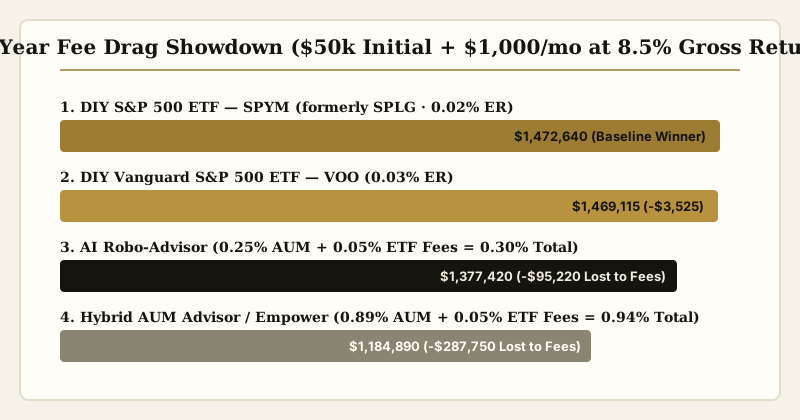
| Investment Strategy | Total Annual Fee | Year 10 Balance | Year 20 Balance | Year 25 Ending Wealth | Wealth Lost to Fees vs. DIY SPYM |
|---|---|---|---|---|---|
DIY Low-Cost S&P 500 (SPYM) |
0.02% / yr | $298,412 | $887,190 | $1,472,640 | $0 (Baseline Winner) |
DIY Vanguard S&P 500 (VOO) |
0.03% / yr | $298,195 | $885,620 | $1,469,115 | -$3,525 |
| AI Robo-Advisor (0.25% AUM + 0.05% ETF fees) | 0.30% / yr | $292,388 | $844,290 | $1,377,420 | -$95,220 Lost |
| Hybrid Advisor / Empower (0.89% AUM + 0.05% ETF fees) | 0.94% / yr | $279,104 | $754,610 | $1,184,890 | -$287,750 Lost |
💡 Run this math on your own exact portfolio: Use our interactive Fee Impact Calculator or grab our Python calculator prompt in 10 ChatGPT & Claude Prompts to Audit Your Stock and ETF Portfolio.
⚠️ The 3 hidden tax & fee traps of Robo-Advisor Tax-Loss Harvesting
Robo-advisors claim their automated Tax-Loss Harvesting in taxable brokerage accounts easily beats that $95,220 fee gap. While TLH can be valuable in years 1–5 for high-bracket earners, our CFP® & AI Audit Council flagged three critical traps you must understand before signing up:
1. IRC § 1211(b) capital loss netting priority
Harvesting $10,000 in paper losses does not lower your taxable W-2 salary by $10,000. Under 26 U.S. Code § 1211(b), harvested capital losses must first offset realized capital gains dollar-for-dollar. Only if you have leftover net losses can you deduct a maximum of $3,000 per year ($1,500 if married filing separately) against ordinary paycheck income — with excess losses carrying forward under IRC § 1212(b).
2. The external IRA cross-account wash sale death trap (IRS Revenue Ruling 2008-5)
The IRS Wash-Sale Rule applies across every account owned by you and your spouse.
- Internal vs. External Coordination: If you hold both your taxable account and your IRA inside the same robo-advisor (such as Betterment), their software coordinates across those internal accounts to avoid wash sales.
- The External Blind Spot: However, no robo-advisor can block trades happening inside your external Fidelity/Vanguard Roth IRA, your workplace 401(k), or your spouse’s brokerage account.
- Permanent Destruction of Your Tax Deduction: Under IRS Revenue Ruling 2008-5, if your robo-advisor sells an ETF at a loss in your taxable account, and within 30 days before or after that sale your external Roth IRA or Traditional IRA automatically buys or reinvests dividends (DRIP) into a substantially identical fund, the taxable loss is disallowed as a wash sale. Worse, because you cannot increase the cost basis of an IRA, that tax deduction is permanently destroyed forever.
3. The mature portfolio “Tax-Lock Trap” (concrete dollar example)
Suppose you invest $50,000 in a taxable robo-advisor account and harvest losses during early market dips, lowering your tax cost basis down to $32,000. Ten years later, after a long bull market, that portfolio has compounded to $150,000. Because every single tax lot is now sitting on massive unrealized gains well above your $32,000 basis, the robo-advisor generates $0 in new harvested tax losses.
Yet you are still paying the 0.25% annual AUM fee ($375/year on $150,000, growing every year). If you try to sell your robo-advisor’s complex web of 12 alternate ETFs to switch to a simple 0.02% DIY ETF, you trigger a massive capital gains tax bill on $118,000 of embedded gains — effectively locking you into the fee forever.
Final verdict: when to use a Robo-Advisor vs. DIY ETFs
- 🏆 Never use a 0.25% Robo-Advisor for a Roth IRA or Traditional IRA: Inside tax-sheltered retirement accounts, Tax-Loss Harvesting provides zero benefit. Buy low-cost index ETFs like
SPYM(0.02%) orVOO(0.03%) directly at Fidelity, Vanguard, or Schwab. - ✅ When a Robo-Advisor Actually Makes Sense: You are in a high federal tax bracket (32%–37%), you are investing $50,000+ in a taxable brokerage account, you do not buy identical index funds inside external IRAs, and you want 100% hands-off rebalancing.
- 🛠️ Track your DIY ETFs for free: Read our hands-on setup guide: Google Finance AI Portfolio Scanner Tested: Our $25,000 Model Portfolio Review.
Frequently asked questions
Did the SPLG S&P 500 ETF change its ticker symbol to SPYM?
Yes. Effective October 31, 2025, State Street Global Advisors officially updated the ticker symbol of the SPDR Portfolio S&P 500 ETF from SPLG to SPYM (State Street SPDR Portfolio S&P 500 ETF). The underlying S&P 500 holdings and industry-low 0.02% expense ratio remained completely unchanged.
Does robo-advisor tax-loss harvesting work in a Roth IRA?
No. Tax-loss harvesting only applies to taxable brokerage accounts. Selling investments at a loss inside a Roth IRA or Traditional IRA generates zero tax deductions — meaning you pay the 0.25% robo-advisor fee without receiving any tax-harvesting benefit.
How can an external IRA accidentally ruin robo-advisor tax-loss harvesting?
Under IRS Revenue Ruling 2008-5, if a robo-advisor sells an ETF at a loss in your taxable account, and you or your spouse purchase or auto-reinvest dividends into a substantially identical fund inside an external IRA within 30 days before or after the sale, it triggers a wash sale that permanently destroys the tax deduction.
Put this advice to work — tonight
Our budget templates do the math for you: type your income in one green cell and see exactly where every dollar goes. Spreadsheets for Excel & Google Sheets, plus a printable planner pack.
Browse the templates → $7–$15 one-time · Instant download · Excel, Google Sheets & printable